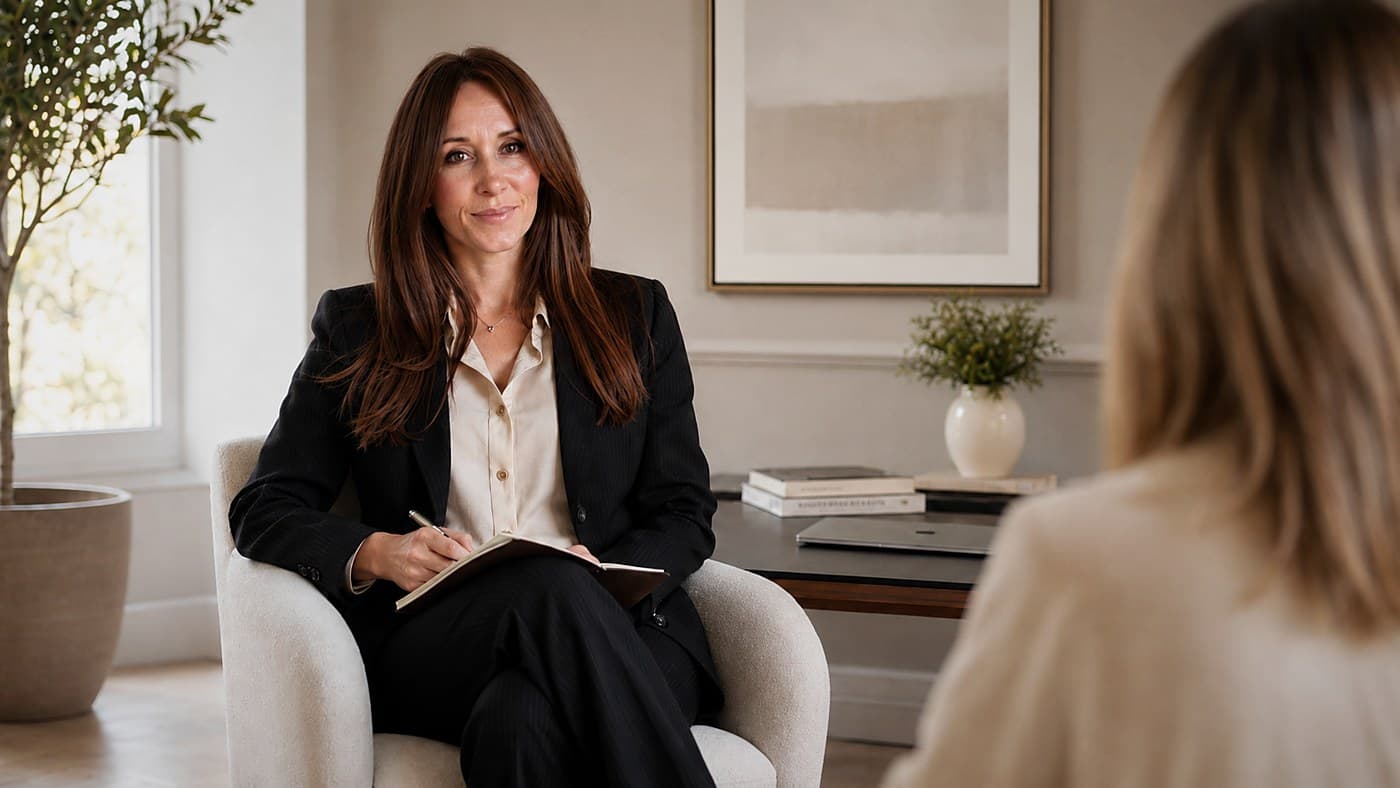
Coach & confidante
For the people who are supposed to have it all together.
Someone to sit with, who can help you understand your own world. Sometimes it is simpler than that: building the skills to live in the world you find yourself in.
Discreet, psychologically informed work on perfectionism, pressure, performance and discovery. Most of it is in law, finance, high-performance sport, and with people whose names are publicly known.
Who I coach
Success rarely arrives with an off switch.
The people I work with are, by any external measure, doing brilliantly. That’s usually the problem. The same drive that built the career - the exacting standards, the refusal to drop a ball, the quiet conviction that resting is falling behind - starts charging interest. It shows up as decision fatigue, a shorter fuse, sleep that doesn’t restore, and a creeping sense that the person everyone relies on has nobody sensible to think with.
This isn’t therapy, and it isn’t motivational cheerleading. It’s structured, confidential work with someone who has spent 25+ years in mental health and understands exactly what high performance does to a human being.
I am a Registered Mental Health Nurse (BSc Mental Health Nursing), MSc Occupational Psychology. I trained and worked in the NHS from 2001 - community mental health, crisis, psychiatric liaison, PICU and forensic settings - and took the MSc at Goldsmiths, University of London. That is the difference between a coach who has read about this and a clinician who has sat with it.
The same pattern, wherever it turns up
Different pressures, identical mechanics underneath: a very high standard, an audience, and no obvious place to put any of it down. These are where I see it most often. They are not a list of who qualifies.
- LawIncluding six years and counting retained by a Magic Circle firm
- FinanceIndividuals and the teams built around them
- High-performance sportWhere the performance is the person
- Public figuresPeople whose work is carried out in front of an audience
- Founders and family businessWhere the company and the person are hard to separate
- Senior leadershipAnyone carrying an organisation, in any sector
What I coach
What we actually work on.
- Perfectionism and its costsThe standards that built the success, and what they’re quietly taking in return - examined properly, not pathologised.
- Pressure, visibility and consequenceLeading when every decision is watched, and the gap between the public role and the private person widens.
- Performance without self-destructionStaying at the top of the game without running on empty - grounded in behavioural science, not wellness clichés.
- Discovery, and the plain practical stuffSometimes it is not a pattern to unpick at all. It is working out what you actually want, or building the skills to live in the world you find yourself in.
How I coach
Quietly, and properly.
Regular sessions over a defined period, in person or remote. Not surface-level motivation, and not a fixed programme you are put through - I adapt to the person rather than running everybody past the same set of slides.
The conversation first
Every engagement starts with a confidential conversation - no forms, no assessment funnel. We work out whether this is the right fit, and I’ll tell you honestly if it isn’t.
Then the work
I draw on training across ninetherapeutic and coaching modalities and an MSc in Occupational Psychology, but you’ll hear straight talk, not jargon.
Discretion is a given, not a feature. Nothing about the individuals I work with or what we discuss is shared, referenced or used as marketing without explicit permission - and I ask rarely.
Not ready for private work? The Perils of Perfectionism is my self-guided workbook series - the same clinical thinking, at your own pace.
Honest answers
Fair questions, answered honestly.
What does it cost?
We discuss it on the call. The work is not one fixed thing, so a price list would be a guess at what you need before I know anything about it. You will have the figure before you commit to anything, and there is no charge for the first conversation.
Do you work in person or remotely?
Both. I am based in London and see people here, and I travel when the work calls for it. A good deal of it is remote, which for people who are rarely in one country for long is usually the point rather than a compromise.
How often would we meet?
It starts with a period of onboarding while we get to know one another, because nothing useful happens until I understand how you actually work. After that it is usually monthly, and more often if something needs it.
Is there a waiting list?
Yes. I keep the practice small enough to do it properly, so there is usually a wait. It is worth getting in touch anyway, because it moves, and a conversation now is how you get a place when one comes up.
Is this therapy?
No. I am a Registered Mental Health Nurse, and the clinical training is what makes this more than encouragement, but coaching and confidante work is not therapy, psychiatric treatment or a diagnosis, and it does not replace a treating team or a GP. If what you need is clinical, I will say so.
Next step
One email. No pitch.
Tell me a little about the situation - or nothing at all beyond wanting to talk. I read everything myself.
info@stacythomson.co